Spain’s World Cup 2026 Victory Sparks Record-Breaking $50 Billion Global Betting Boom
July 24, 2026 — When substitute Ferran Torres found the back of the net in the 106th minute at MetLife Stadium in New Jersey, he didn’t just deliver Spain’s second FIFA World Cup title — he triggered the largest single-day sports betting settlement in history. Spain’s gritty 1-0 extra-time victory over Argentina on July 19 capped a six-week tournament that shattered every betting record imaginable, with global handle surpassing an unprecedented $50 billion across regulated sportsbooks, offshore operators, crypto platforms, and prediction markets.
The 2026 World Cup, the first ever staged across three host nations — the United States, Canada, and Mexico — with an expanded 48-team format, was always expected to drive massive wagering volumes. But few anticipated the sheer scale of the explosion. According to industry data consolidated from major operators, the Spain-Argentina final alone accounted for more than $5.5 billion in handle, making it the most-bet soccer match in history.
“The 2026 World Cup fundamentally changed the sports betting landscape in North America,” said a senior analyst at a leading gaming consultancy. “What we witnessed was a perfect storm: the first home-soil World Cup for the US since 1994, legalized sports betting in 38 states plus Washington DC, the rise of prediction markets, and a generation of fans who treat in-game micro-betting as part of the viewing experience.”
By the Numbers: A Tournament Like No Other
The statistics from the tournament are staggering. Caesars Sportsbook reported that the World Cup Final produced a handle that was 65% higher than the previous record for a soccer event. FanDuel and DraftKings both reported their busiest single days in company history, with live in-play betting accounting for over 60% of all wagers placed during the final match.
But the real story of 2026 was the meteoric rise of prediction markets. Kalshi and Polymarket combined to handle an extraordinary $45 billion in June alone, with prediction market contracts capturing approximately 27% of all US sports betting activity during the World Cup — up dramatically from just 9% in January 2026. Kalshi’s Spain-Argentina championship contract alone surpassed $1.27 billion in volume, making it the most heavily traded single-event contract in prediction market history.
The expanded tournament delivered what FIFA had promised: chaos, upsets, and drama. Cape Verde made a stunning debut run, Norway eliminated Brazil, and England secured a third-place finish after a wild 6-4 victory over France in which Kylian Mbappé scored twice to claim the Golden Boot with 10 goals — the first double-digit haul since Gerd Müller in 1970.
The Final That Defied the Odds
On paper, the final promised fireworks. Argentina entered as defending champions, led by the legendary Lionel Messi playing what was widely expected to be his final World Cup match at age 39. Spain, meanwhile, had conceded just one goal all tournament — the fewest ever by a champion — and played the most controlled, possession-oriented football of any side in the competition.
What transpired was a match that frustrated neutrals but fascinated bettors. Argentina played a deeply conservative game, seemingly content to take the match to penalties. The statistics tell a damning story: Argentina became the first team in World Cup final history to register zero shots on target in regular time. Emiliano Martínez, Argentina’s heroic goalkeeper, was kept busy at the other end, making a record 11 saves in a World Cup final — the most ever — as Spain peppered his goal with 12 shots on target across the 120 minutes.
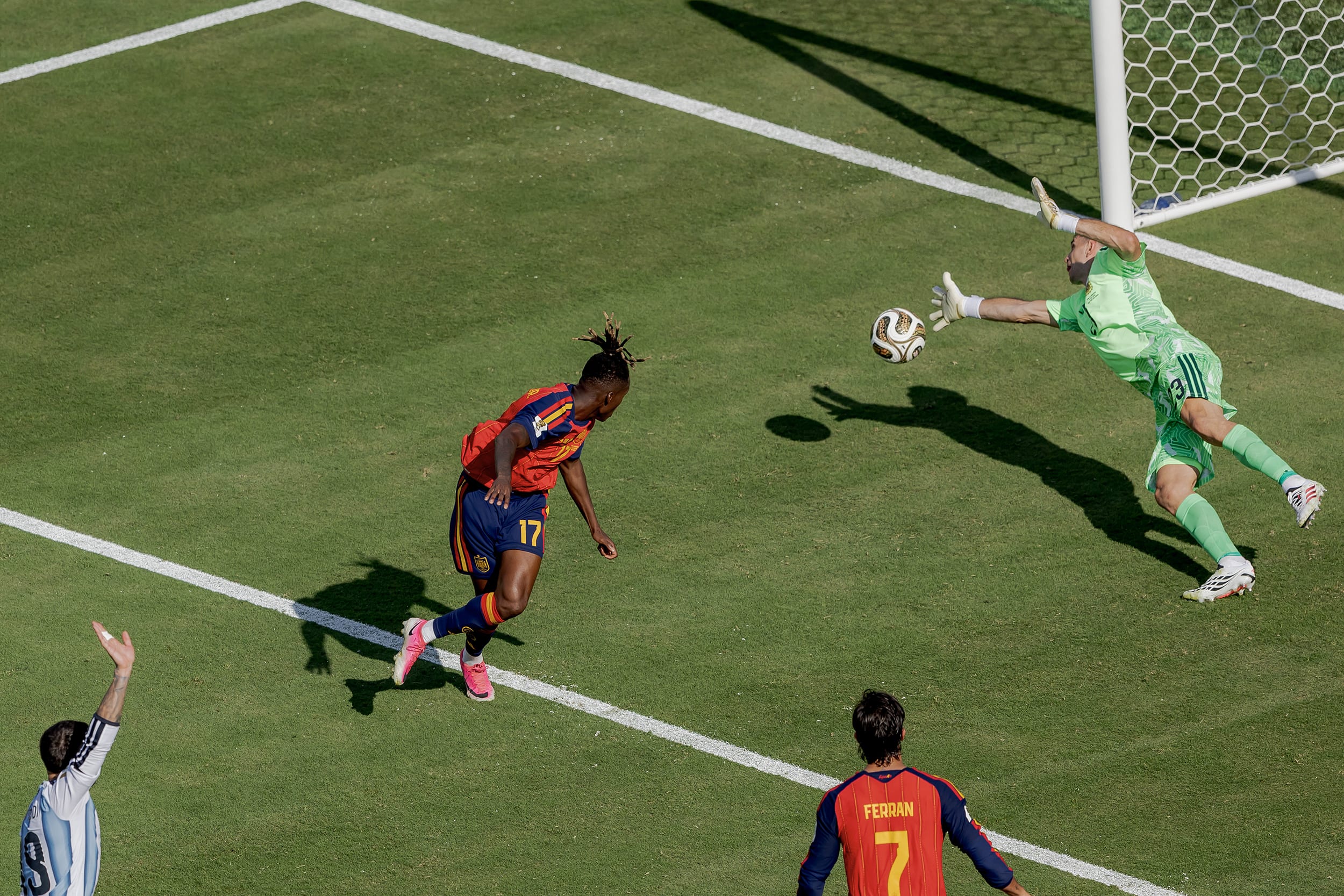
The match turned in second-half stoppage time when Argentina’s Enzo Fernández collected a second yellow card for a reckless challenge on Pau Cubarsí, reducing the defending champions to 10 men through extra time. Spain pressed their advantage, and the breakthrough finally came in the 106th minute: Pedro Porro’s cross found Nico Williams, who headed the ball into the path of substitute Ferran Torres. Torres smashed home from close range to send the Spanish bench into ecstasy and the Argentina supporters — packed into MetLife Stadium — into silence.
Drake’s $1.5 Million Curse Strikes Again
No betting story of the tournament generated more headlines than the continuing saga of the so-called “Drake Curse.” The Canadian rapper and global superstar placed a $1.5 million USDT bet on crypto sportsbook Stake, backing Argentina to win in regulation at +245 odds — a slip worth $5.175 million if it had hit. It was structurally identical to the $1 million bet on Argentina that cost him dearly in the 2022 final, when Argentina won the trophy but drew in regulation.
History repeated itself in crueler fashion. Drake’s bet died twice: first when the match went to extra time, and again when Spain lifted the trophy. Social media exploded with memes mocking the rapper’s misfortune. According to TheDrakeCurse, which tracks his documented wagers, Drake’s public sports bets now stand at 35 wins from 97 documented wagers since February 2022, with $38.72 million wagered and a net loss exceeding $1.56 million — a figure that doesn’t include this latest loss.
The irony, of course, is that these viral tickets serve as unpaid advertising for Stake, which reportedly pays Drake $100 million annually as a brand ambassador.
The Rise of Micro-Betting and Novelty Markets
The 2026 World Cup was also the tournament where micro-betting went mainstream. Operators reported that same-game parlays and micro-markets — bets on individual corners, yellow cards, throw-ins, and even VAR reviews — were their highest-margin products. For every viral winner, thousands of smaller losing bets quietly funded the operator’s bottom line.
Prediction markets pushed boundaries further. Listings included whether any single match would break the record of 19 yellow cards, which player would receive the first card, and the exact minute of the first substitution. Integrity analysts warned that card and VAR markets represent the softest targets for spot-fixing, since one booking is far cheaper to buy than a match result.
Among the notable wins: a bettor at Russian bookmaker PARI turned approximately $155,000 into nearly $490,000 by backing Switzerland vs Colombia to draw in regulation at +215 odds — the book’s largest single payout of the tournament. Former adult film star Mia Khalifa also made headlines by showing a verified $1.65 million win on Spain to lift the trophy.
What the 2026 World Cup Means for Sports Betting’s Future
The $50 billion handle from the 2026 World Cup has fundamentally altered the trajectory of the global sports betting industry. With the United States now the undisputed center of the sports betting universe — 38 states and Washington DC having legalized since the 2018 PASPA repeal — the tournament served as a live demonstration of the market’s potential.
Analysts project that the success of the 2026 World Cup will accelerate legalization efforts in the remaining holdout states, including California, Texas, and Georgia. The tournament also showcased the growing influence of crypto-native betting platforms like Stake and the convergence of traditional sportsbooks with decentralized prediction markets.
FIFA’s anti-time-wasting rules also had a noticeable impact on betting patterns. The new five-second countdown on throw-ins and goal kicks, the 10-second substitution exit rule, and expanded VAR powers to review corner awards and second-yellow red cards all created new betting angles and markets. Fans and bettors alike adapted quickly to the faster pace of play.
For Spain, the victory marks the country’s second World Cup title, 16 years after their 2010 triumph. Sixty-five-year-old Luis de la Fuente became the oldest coach to win a World Cup. For Argentina and the 39-year-old Messi — who became the first player to start three World Cup finals and closed on 21 World Cup goals — it was a painful end to what may be the final chapter of the greatest career in football history.
And for the global betting industry, the 2026 World Cup will be remembered not just for the football, but as the moment the floodgates truly opened.
—
Stay ahead of the action with Kaiyun MK — your premier destination for World Cup betting, live odds, and exclusive promotions. Visit Kaiyun MK today and join the winning side.